 17 May 2026
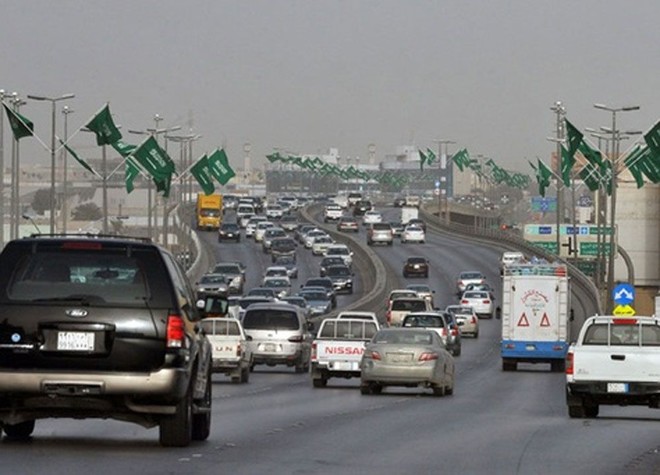
"The Ministry of Transport's monthly traffic report showed that total traffic on the Kingdom's roads under its jurisdiction and equipped with traffic monitoring devices reached a new record high in June, reaching 60 million trips, a 3.0% increase compared to the previous month (May).
With this new high, total traffic on all of the Kingdom's roads—which exceed 68,000 kilometers in length—reached approximately 329 million trips in the first half of 2018. This coincided with an increase in the number of traffic counting units on all roads, from 196 units at the beginning of 2018 to 219 units by the end of last June, an increase of 11% in the first six months of this year.
It is worth noting that the Ministry of Transport's monthly report relies on three main pillars: assessing service levels on road connections,
a daily traffic report on the road network, and a traffic accident report. This comes within the framework of the Ministry's ongoing efforts to improve the performance of the road network in the Kingdom, according to an integrated vision aimed at achieving the best levels of operation, raising the level of safety, and reducing accidents.
The June report indicated that the Makkah region continued to be the most congested region, at almost the same level as the previous month (May).
Makkah's roads accounted for a total of 25.3 million trips, representing 42% of the total traffic on the Kingdom's roads as a whole,
followed by the Eastern Province with a total of 12.5 million trips. (20.8%), followed by the Riyadh region with a total exceeding 7.1 million trips (11.8%).
The traffic report includes an assessment of service levels on roads, achieved through an analysis of volume-to-capacity ratios and vehicle speeds on key freeway connections,
including several roads with high traffic volumes. To assess service levels on these roads using available data,
two methods were employed. The first method estimated service levels for the most congested roads in the Ministry's road network based on volume and density.
The report showed that the highest density road was the Makkah-Jeddah (Haramain) Road, with a total of 2.9 million trips,
and an average of 92,000 cars and 5,800 trucks. This was followed by the Jeddah-Makkah (Haramain) Road, with a total of 2.2 million trips,
and an average of 66,500 cars and 6,700 trucks. The third method estimated service levels for the most congested roads in the Ministry's road network based on average speed.
The Jeddah-Makkah (Haramain) Road recorded the highest average speed. A total exceeding 2.2 million vehicles and a daily average of over 73,000 vehicles.
This was followed by the Tabuk-Madinah Road (Second Ring Road) with a total exceeding 1.8 million vehicles and a daily average exceeding 60,000 vehicles.
Then the Madinah-Tabuk Road (Second Ring Road) with a total exceeding 1.7 million vehicles and a daily average of approximately 59,000 vehicles.
Furthermore, the traffic report for June 2018 indicated that the Riyadh entrance from the Qassim Road recorded the highest traffic among the capital's entrances,
according to traffic count units, it exceeded 75,000 vehicles. In Makkah, the entrance from the Al-Sail Road had the highest traffic volume, exceeding 40,000 vehicles.
Regarding speeding on several roads, the traffic report identified roads where small cars exceeded 140 km/h,
and trucks exceeded 100 km/h. The Riyadh-Bisha road ranked first with a rate of 52%. The Al-Hawtah-Al-Aflaj road came in second with 46%, followed by the Najran-Al-Sulayyil road with 45%. The report also indicated that some roads had high rates of truck overtaking.
The Taif-Mecca road ranked first with 97%, followed by the Mecca-Taif road at 90%, and then the Al Wajh-Umluj road at 81%.
Regarding monitoring traffic flow at road interchanges in Riyadh and the Al-Uyun-Al-Uqair road in the Eastern Province,
The report indicated that the highest average traffic volume was recorded at the interchange located after the Diwan Tunnel heading west,
with an average exceeding 25,000 vehicles per day, followed by the interchange at Exit 8 heading north towards Exit 7, with an average exceeding 24,000 vehicles per day.
The report also showed that the average traffic flow on the Al-Uyun-Al-Uqair road exceeded 503 vehicles per day during June 2018.
It is worth noting that the traffic flow report is a fundamental pillar for preparing expansion plans and developing the road network based on traffic density.
Traffic statistics are included in strategic transportation plans. Studying and analyzing traffic flow, including the number of accidents and speed rates,
In addition to identifying the types of technical and engineering interventions needed on roads to enable them to benefit from the final outputs of security agencies,
and road safety, and prioritizing maintenance for roads with high traffic volumes."
 Head Office :
0537366641
Head Office :
0537366641




 Contact